
For most traders, choosing a tradable instrument goes like this: they hear crypto is hot, so they trade crypto. Or they read that forex is "the world's most liquid market," so they dive in. Or someone on a forum says small-cap stocks are where the real money is, and off they go.
That is the wrong approach.
The right question is not "what can I trade?" It is "what should I trade based on how my system is designed to work?"
After 20 years of systematic trading across Australian equities, US stocks, Canadian markets, Hong Kong, and around 40 futures markets spanning every major asset class, I have learned this: the instrument is secondary. The system comes first. The instrument has to serve the system.
This guide walks you through the main categories of tradable instruments - and more importantly, how a systematic trader evaluates them.
What Are Tradable Instruments?
A tradable instrument is any financial asset or contract that can be bought and sold on a market. The term covers a wide range - from a share in Apple or BHP, to a futures contract on crude oil, to a currency pair like EUR/USD.
Tradable instruments generally fall into two broad categories:
Cash instruments - assets whose value is determined directly by the market. Stocks, ETFs, and spot forex fall here. You buy the asset outright (or close to it).
Derivative instruments - contracts that derive their value from an underlying asset. Futures, options, CFDs, and swaps sit in this category. You are not buying the underlying asset - you are buying a contract whose value moves with it.
This distinction matters because derivative instruments typically involve leverage, and leverage changes everything about how you size positions, manage risk, and evaluate returns.
What Are the Main Types of Tradable Instruments?
Stocks (Equities)
Stocks represent ownership in a company. When you buy shares, you own a fraction of that business and participate in its growth or decline.
For systematic traders, stocks are the natural starting point. They are regulated, liquid in the major markets, and available on exchanges with clear open and close times. Critically, they are not inherently leveraged - which means you are not paying interest on borrowed capital just to hold a position.
Stocks can be traded across multiple markets globally: US, ASX, TSX, London, Hong Kong, and more. Each market has distinct characteristics that affect which systems perform well there. More on that below.
ETFs (Exchange-Traded Funds)
ETFs are baskets of securities that trade like a single stock on an exchange. They can track indices, sectors, commodities, or custom strategies.
For systematic traders, ETFs have one important advantage over individual stocks: they do not go to zero. A single company can collapse. An ETF tracking 500 companies will not. That makes them attractive for certain system types - particularly those that need high liquidity and want to avoid catastrophic single-position events.
The tradeoff is lower individual volatility. Some systems that rely on large single-stock moves will underperform on ETFs. Systems designed for ETF characteristics - built from the ground up on ETF price behaviour - tend to work better than stock strategies ported across.
Futures
A futures contract is an agreement to buy or sell an asset at a predetermined price on a future date. Futures exist across equity indices, commodities, interest rates, and currencies.
The main attraction for systematic traders is diversification. Running trend following systems across 40 different futures markets - energies, metals, agricultural products, interest rates, currency pairs - gives you genuinely low correlation between positions. When equity markets are grinding sideways, a commodity market might be trending hard. That is where the real risk-adjusted return improvement comes from.
Futures do require larger capital. Contract sizes are set for institutional-scale deployment, and smaller accounts will struggle to size positions correctly without taking on disproportionate risk per trade.
Forex (Currency Pairs)
Forex is the world's most liquid market, with trillions changing hands daily. It is promoted everywhere as the ideal trading instrument.
I traded forex extensively and eventually abandoned it for systematic purposes. Here is the core problem.
Forex pairs move small percentages. To generate a meaningful return at the account level, you need significant leverage - often 10x to 50x. That leverage does not just magnify your returns. It magnifies your costs. The spread on a major pair looks tiny, but multiply that spread by 50x leverage and you are paying a significant cost on every entry and exit.
Compare that to stocks, where a single position can deliver a 30%, 50%, or 100% move with no leverage at all. The expectancy of a well-designed stock system is often far higher than a leveraged forex approach, even after accounting for the lower liquidity of individual names.
There is also a structural problem for end-of-day traders, which I will cover in detail below.
Cryptocurrency
Crypto has attracted enormous trader interest, and the volatility is real. Prices can move 30-50% in weeks in ways that equity markets rarely do.
That volatility is the attraction for systematic traders. Large moves mean higher profit per trade, which can offset higher transaction costs and wider spreads.
The challenge is correlation. Crypto tends to move with risk assets during broad market panic. When everything sells off, crypto sells off harder. The diversification benefit can disappear exactly when you need it most. However, adding crypto to an all-stock portfolio can give you some significant benefits because the bull markets are not highly correlated with stocks and they tend to be extremely strong.
If you trade crypto systematically, position sizing is everything. Crypto's volatility is extreme enough that even a small allocation can dominate your portfolio's total drawdown. The systems need to be built specifically for crypto's market structure - not equity strategies transplanted and hoped for the best.
CFDs (Contracts for Difference)
CFDs let you trade price movements in stocks, indices, and commodities without owning the underlying asset. They are popular for the easy access to leverage and short selling.
I do not use CFDs for systematic trading. The cost structure is the problem.
With a CFD, you pay interest on your entire position value - not just the initial margin. As your position grows, your interest charges grow with it. I learned this painfully: a stock I held on CFDs ran from a $15,000 position to $140,000 in value. The interest on that $140,000 position eventually required me to sell units of the position just to fund the carrying costs. That is not a trading edge - it is a structural drain.
CFDs also create a backtesting mismatch problem. If you backtest on a universe of stocks but trade via a CFD provider, your broker will not offer CFDs on every stock in that universe. The CFDs available today represent a survivorship-biased set - the instruments liquid enough for the broker to profit from. Instruments that failed or lost relevance are gone. Your real-world results will not match your backtest, because you were never actually trading the same universe.
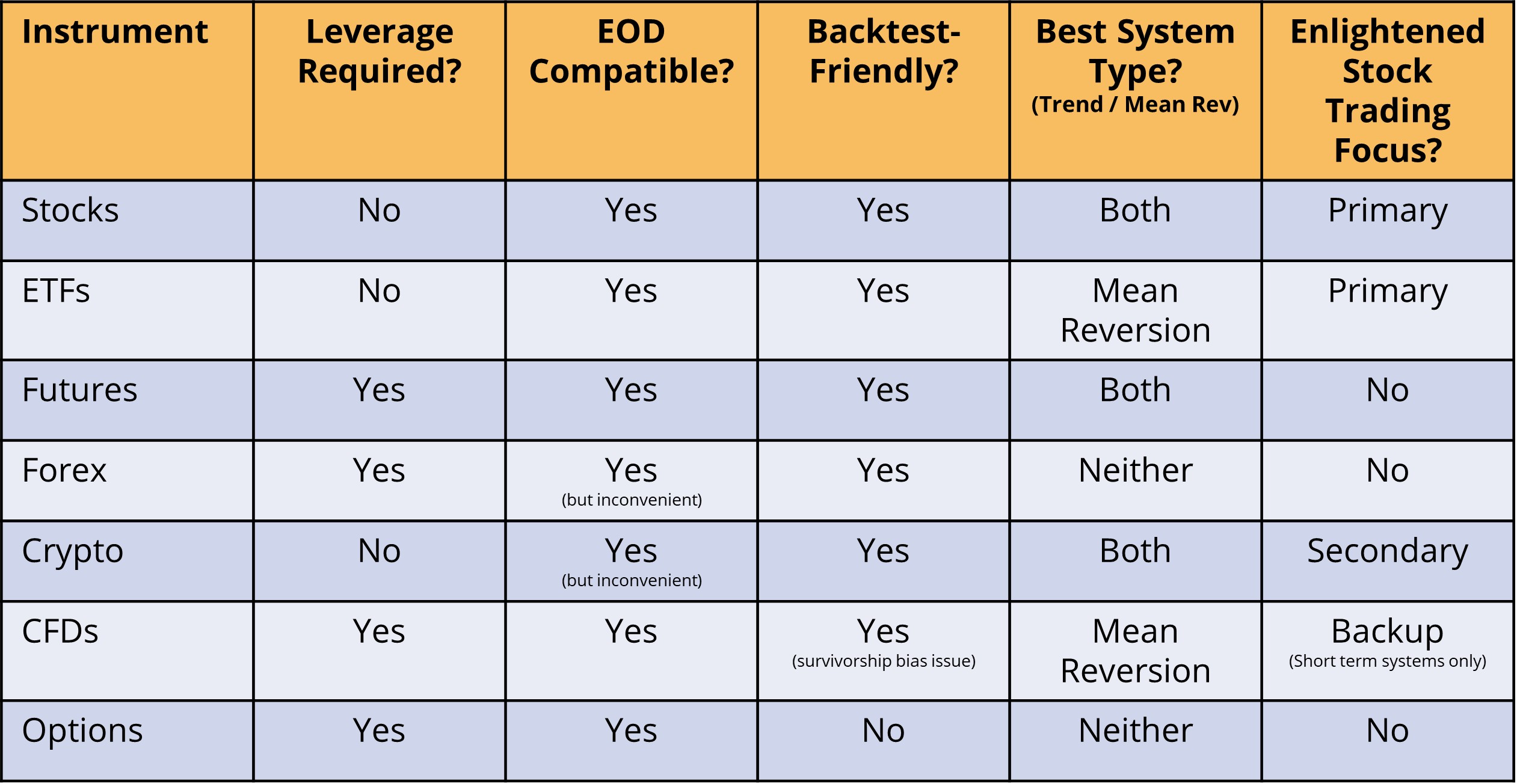
How Does a Systematic Trader Choose Which Instruments to Trade?
The wrong question: "What can I trade?"
The right question: "What does my system actually need in an instrument to perform the way it did in the backtest?"
Your system has specific requirements - for liquidity, volatility profile, market hours, data quality, and capital scale. The instrument either meets those requirements or it does not. If it does not, live results will diverge from the backtest.
Liquidity is the most important filter.
Not because you need to feel comfortable, but because liquidity directly determines your position sizing capacity and slippage exposure.
The threshold depends on your system type. A mean reversion system that makes 1-2% profit per trade cannot absorb much slippage - even a small fill cost eats a disproportionate share of that expectancy. Those systems need strict liquidity filters. A trend following system with higher average profit per trade, spread across 20-25 positions, can tolerate lower individual liquidity - each position is small relative to the universe, and slippage has less impact on the overall return.
For ETF systems with serious capital, $10 million in average daily dollar volume is a conservative floor. For individual stock systems, I have tested ranges from $250,000 to $1 million in 20-day average daily turnover, landing around $500,000 to $1 million for a reasonable threshold on the NYSE. On the short side, I require even higher liquidity - getting out of a short under pressure is harder than closing a long.
Data quality is the second critical filter.
If you are backtesting on today's S&P 500 constituents going back 20 years, you are pre-selecting the survivors. Companies that failed or were delisted are not in the index today. You are essentially time-travelling to pick only the stocks you know will succeed. That inflates backtest returns dramatically and tells you nothing about what you would have actually made.
Norgate Data is the only vendor I recommend for historically accurate index constituents. The difference in backtest results between survivor-biased and clean data is significant.
Delisting survivorship bias is a different story. For long-side trend following with proper exits, a company trending toward bankruptcy usually gives you an exit signal before the collapse. In 25 years and tens of thousands of trades, I have had two unexpected delistings - neither on Australian, US, or Canadian stocks. Hong Kong and Shanghai are messier on this front. On the whole, delisting bias is less dangerous than people claim for systematic equity strategies.
Market hours compatibility is the third filter for EOD traders. More in the forex section below.
Which Tradable Instruments Suit Trend Following Systems?
Trend following works across many instruments. I have backtested it on Australian equities, Canadian equities, US equities, European markets, UK markets, and Hong Kong. The equity curves show it works globally. I have also run it across futures markets in energies, metals, agricultural products, and indices.
The instruments that suit trend following share a few characteristics:
- A defined daily close - You need a clear signal at the end of each session to evaluate your positions and plan the next day.
- Enough percentage volatility to generate meaningful trend moves - not just noise that chews through transaction costs.
- Sufficient liquidity to enter and exit at close to the theoretical backtest price.
Stocks tick all three boxes. So do ETFs for larger capital accounts. Futures across commodities and indices are excellent trend following vehicles - and they offer genuinely lower correlation between markets, which can improve risk-adjusted returns significantly compared to a stock-only approach.
Hong Kong is worth calling out. The market rockets up fast and crashes down hard - very different from the ASX's steadier grind. Long-term trend following is harder there. Shorter swing-style strategies tend to perform better. The diversification benefit is excellent though, because Hong Kong's heavy China exposure means it responds to different macro drivers than Western markets.
Options are not particularly useful for trend following, because all options contracts have an expiry date. This means you have to roll over multiple times, and that creates additional costs as well as uncertainties around profitability, because we do not know what the option price will be at the point of rollover. It varies dramatically with volatility.
Which Tradable Instruments Suit Mean Reversion Systems?
Mean reversion strategies identify stocks that have moved sharply away from their recent average and bet on a snap back.
These systems have specific instrument requirements:
- High individual liquidity - Mean reversion profits per trade are smaller than trend following. Slippage hurts proportionally more. Strict liquidity filters are non-negotiable.
- Volatile but structured price behaviour - Mean reversion needs instruments that oscillate around a range, not ones that trend persistently or drift randomly.
- Larger cap markets - Small illiquid stocks can gap through your target exit without filling, breaking the expected return profile entirely.
US large and mid-cap stocks are the ideal universe. The ASX works for smaller capital accounts with an Australian focus.
Forex is difficult for mean reversion. Currency pairs can trend persistently for months - sometimes years - and show fewer of the clean oscillation patterns that mean reversion depends on. Crypto can also be useful for mean reversion trading - the volatility is extreme which makes for good mean reversion potential. However, it is important to ensure that you trade crypto tokens with sufficient liquidity and have disaster exits or time stops in place to get you out of tokens that continue trending in the wrong direction and do not ultimately mean revert, otherwise losses can mount quickly.
Can You Trade Multiple Instruments to Diversify Your Portfolio?
Yes - and this is where systematic trading becomes genuinely powerful.
The real driver of my results over 20+ years has not been finding one magical instrument (or system). It has been diversification across markets and strategies simultaneously.
The point is not that one instrument is crushing it. The point is not betting everything on one market or one approach. When trend following struggles in equities for a period, positions in other asset classes are producing. When one trading system hits a rough patch, another is performing. The portfolio smooths what individual systems cannot.
But diversification across instruments only delivers if the returns are genuinely uncorrelated. Here is the mistake most traders make: they look at raw statistical correlation numbers between markets, see "moderate correlation - good diversification," and call it done. That misses the real work.
What actually matters is how your specific systems perform across those markets in different regimes. Two markets can be highly correlated on paper but deliver uncorrelated strategy returns if they respond differently to the same technical signals, or if the trends develop at different speeds and at different times.
The way to measure it: backtest your full portfolio together. All systems, all markets, all in one combined backtest. Then look at the maximum combined drawdown versus the worst single component. If the combined drawdown is noticeably lower, diversification is working. If they are nearly the same, correlation is eating the benefit.
On capital allocation: if you are building towards a multi-system portfolio, think backwards from where you want to end up. If you plan to eventually run five systems, each should represent roughly 20% of your capital. Deploy 20% to your first system when it is ready. Leave the rest in cash until the next one is live and proven. Going all-in on one system early, then adding more capital as you add systems, is how you end up over-concentrated at exactly the wrong time.
What Makes an Instrument Unsuitable for Systematic Trading?
Some instruments look attractive in theory but trade poorly for systematic purposes.
Forex - The 24-hour market is the structural problem for end-of-day traders. There is no natural close. Your "daily" bar ends at an arbitrary time - 5pm New York, or whatever your broker decides. The market opens immediately after. That destroys the clean break between market close and analysis that end-of-day trading depends on.
Beyond that, the 24-hour access creates the wrong incentives. It sounds like "more opportunity." What it actually creates is "more temptation to monitor and tinker." I trade to build wealth with low time commitment, not to expand the hours I spend watching charts. And forex brokers are structured to keep you in the market - spreads are their revenue, and high leverage plus round-the-clock access maximises how often you trade and how much you pay.
Options - I have tested multiple options approaches. The fundamental problem is backtesting. A complete systematic backtest requires data on every strike price, every expiration date, for every underlying, for every historical bar. The volume is enormous, and you need to know which specific contract you would have traded at the time. Options backtesting platforms are improving, but right now the technology is not practical for most traders. Without a complete backtest, you cannot know whether you have an edge. Trading without that knowledge is speculation, not systematic trading.
CFDs for systematic use - The interest cost, the mismatched universe, and the order book limitations all work against you. Many CFD providers do not give you access to the full order book - you cannot place limit orders between the bid and ask the way you can with the underlying stock. If you need short exposure, a margin account with a proper broker is cleaner.
Thinly traded instruments - Any instrument where your order represents a meaningful percentage of daily volume creates slippage problems. This is not a category - it is a characteristic that applies across categories. The same stock that is perfectly liquid for a $50,000 account becomes problematic for a $5 million account. As capital grows, risk management requires either moving to more liquid instruments or spreading across more markets.
Frequently Asked Questions About Tradable Instruments
What is the best tradable instrument for a beginner systematic trader?
US stocks. Deepest liquidity, no leverage required to produce solid compound returns, commissions close to zero with most modern brokers, well-regulated, and the most optionality as your capital grows. If you are in Australia and prefer local market hours, the ASX works well for a systematic long approach.
Do I need to trade multiple instruments to be successful?
No - but it helps. A single well-built system on one market can produce strong results. Multiple systems across multiple markets smooth the equity curve and reduce the impact of any one strategy underperforming. Build one system first. Add others as your confidence and capital grow.
Can I trade forex as a systematic end-of-day trader?
It is technically possible but the structure works against you. There is no clean daily close. Leverage requirements inflate your cost base. And the small percentage moves in currency pairs make slippage proportionally punishing compared to stock-based systems.
Is crypto a legitimate tradable instrument for systematic traders?
Yes, but treat it differently. Its correlation with risk assets spikes during broad market sell-offs, which may reduce the diversification benefit when you need it most. Its volatility is extreme enough that a single crypto position can dominate your portfolio drawdown. Size it accordingly, and use systems built specifically for crypto's market structure.
How does survivorship bias differ across tradable instruments?
Index constituency bias is the biggest issue for stock traders - backtesting on today's index members means selecting survivors. Use historically accurate data (Norgate Data is the benchmark). For futures, survivorship bias is minimal. For options and CFDs, the bias problems are severe and very difficult to resolve. Options need complete strike and expiration history. CFDs implicitly carry the bias of whichever instruments the broker still offers today.
Can you build a systematic trading system on ETFs?
Yes. ETFs are excellent vehicles for systematic approaches, particularly for larger capital where individual stock positions might be too small relative to your account size to matter. Systems need to be designed around ETF-specific price behaviour - lower individual volatility means different entry signals, different exit logic, and different expectations on profit per trade.
The First Step to Building a System Around the Right Instrument
The instrument is not the starting point. Your edge is.
Define your system first - whether you are looking at trend following, mean reversion, or another approach entirely - then find the instruments that give your system the environment it needs to perform as designed.
If you are still figuring out what kind of trader you want to be, which instruments suit your lifestyle and goals, and how systematic trading actually works in practice, the Trader Acceleration Bundle is designed for exactly that conversation.
It is a free collection of resources that will help you understand the systematic approach, see how experienced traders evaluate instruments and strategies, and take the first concrete steps towards building a rule-based portfolio.
Access it free at enlightenedstocktrading.com/free.
If you're already sold on the idea of mastering systematic trading, then the best thing you can do for your trading goals is to join the Trader Success System. We will help you implement a diversified portfolio of systems you have absolute confidence in over the next six months. Discover The Trader Success System.